


.webp)
.webp)
.webp)
.svg)
Time, Trust, and Tech: Our Investment-Driven Budget
Invest Bangladesh News Desk
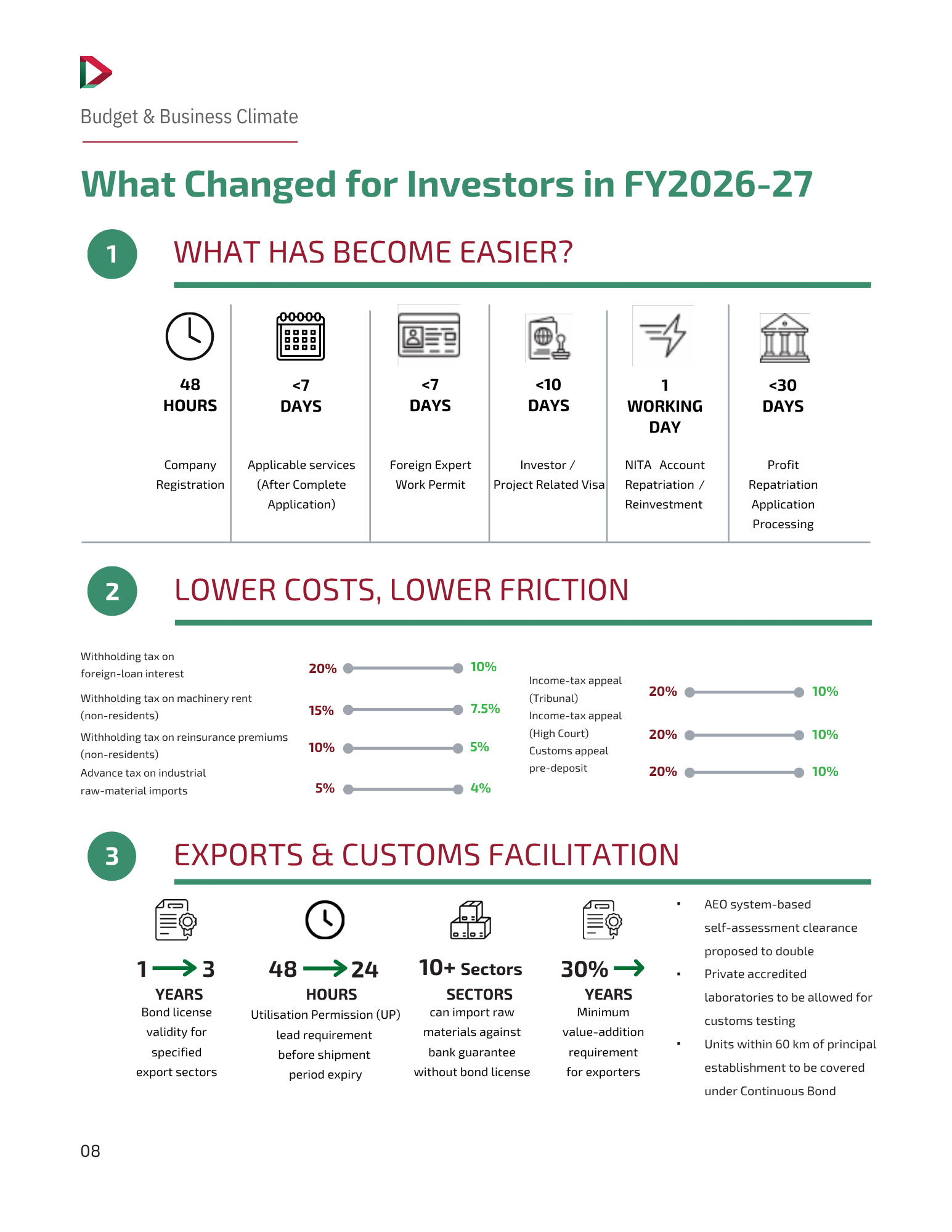
Budgets are usually judged by what they tax and what they spare. Investors have a broader definition of cost. They also pay for time spent waiting for approvals, capital tied up in procedures and uncertainty over whether today’s rules will survive tomorrow’s investment decision. Seen through that lens, Bangladesh’s FY2026-27 Budget is more than a catalogue of concessions. Its investment-policy direction rests on three broad pillars: deregulation, greater policy predictability and targeted support for sectors with potential for new production and value chains. The Budget places particular emphasis on entrepreneurship, export diversification, local value-chain development, renewable energy and technology adoption. Some of the reforms that could matter most to investors are procedural rather than headline-grabbing. Bond licence validity has been extended from 1 year to 3 years. Customs valuation during port entry is moving towards international benchmark databases such as Platts, ICIS, LME and Bloomberg. VAT filing is becoming digital and automated, while manual selection for VAT and income-tax audits is being replaced by software-based risk selection. The pre-deposit required to challenge VAT assessments has also been sharply reduced from 10% to 1% at the appeal and tribunal stages. Ten additional industries, can now import raw materials against bank guarantees without a bond licence, while the previous minimum 30% value-addition requirement has been removed. Together, the deregulation initiatives reduce three things investors repeatedly complain about: time, discretion and uncertainty. The second notable shift is time. Several incentives now extend well beyond a single budget cycle; selected local-manufacturing incentives run through 2030, incentives for semiconductors, electric vehicles and most solar components through 2031, while tax support for solar-power generation extends to 2035. The third shift is strategic prioritisation. ICT and digital services receive fiscal support through startup incentives, lower taxes on technology hardware and zero-duty access for key semiconductor inputs. Renewable energy benefits from support across solar components, battery packs, lithium cells and BESS. Local manufacturing is similarly encouraged across electronics, EVs and medical devices. The common thread
is clear: production, technology capability and job creation. There is one final shift worth highlighting: consultation. For the first time in years, the budget process meant being heard—and seeing ideas debated and acted on. We sought 36 interventions, 70% of which got addressed. The critical test now is execution. The intent and policy direction are clearly set out in the budget; the same level of urgency now needs to translate across every field office.
Budget & Business Climate
.png)
